The Old Poets of China
Wherever I am, the world comes after me.
It offers me its busyness. It does not believe
that I do not want it. Now I understand
why the old poets of China went so far and high
into the mountains, then crept into the pale mist.
I ran from morning to night. There was nothing I couldn’t climb, no height I couldn’t clear, no risk I couldn’t - wouldn’t take. I was wild like the wind, supple as a whip. They offered me a uniform and a desk. I paced in front of the class room windows like a caged leopard. In the end they throw me out. Wild and uncivilised behaviour will not be tolerated from young ladies. Since I cannot not be contained inside, the ‘form’ teacher suggests I should go outside. It was one of her better ideas.
Without walls and ceilings I can relax, whimsy returns, and a sense of spaciousness, spontaneity, receptivity. The air is cool. I loosen my tie. The holly trees that stand perfectly still look like the silence sounds. Beyond the gravel drive stands a great yew tree with a massive girth. Its gnarled branches cast a wide circle of shade in which nothing green grows. The dusty earth is matted with old brown needles that have fallen from the branches. The bright red berries are indecent, plump, sensual.
I lift my body weight with ease and swing from branch to branch until I perch in the crown of the sacred tree. It is a long way down. The silence is intense and captivating. Through the second floor windows of the school house i can see the thin stainless steel u-shaped taps mounted on the science benches, can taste the sweet smell of gas from the bunsen burners, feel the warmth of the blue and orange flames as they flicker. I can hear the diesel engines of the green buses grumbling. The morning workers have disembarked and slowly the seats fill with shoppers. I swing back down branch by branch and a little cloud of dust rises as my polyvelts hit earth.
The school was once been a rich merchant’s estate. The grounds are sizeable. At the edge of the estate is a wood, mostly fir, but some ancient oak and sycamore. The woodland floor is littered with bluebells. I walked through them like someone about to be married. I go straight to the swing which is a length of rope slung around the arm of a great beech tree. The handle of the swing is a gnarled branch with a thick knot of rope in the dead centre.
In order to reach the handle which hangs between the tree, a low sandstone wall and a ten foot drop, I have to run the length of the wall and launch my body into space. Once the branch is caught the momentum of motion, weight, and gravity propel my body through space in a perfect arc around to the furthest side of the beech tree. It is essential to ensure that it is the feet that hit the trunk first. The knees need to bend on impact and then a pause arises, a moment of stillness, silence and balance, before the knees unfold again enabling the body to explode outward away from the trunk. There has to be enough force and momentum for the return trip, to make a perfect arc - the body swinging and twisting, all the time moving away from the body of the tree and out into clear space. At the highest point the body is 20-25 feet above the ground. It requires physical agility, a sensitivity to weight, weightlessness and motion in order to land back on the sandstone wall in the exact same spot. It is a beautiful art. I fly for hours through the silent autumn air, mesmerised by the agility of body and the liberation of weightless flight. Running, catching, swinging, landing, exploding, flying, arcing, twisting, turning, landing. All sensation, heartbeat, balance and body effort. Embodied joy. A jay bursts from a cedar in the dell and I hear the sound of the lunch time bell.
The truth is I that I can’t afford a mortgage, the chain of debt wrapped around the delicate neck of my short life. I cant afford a house in the country but I’ll go mad if I live in a city. Because I am already mad I cannot afford to live the life required to earn enough money to buy the house in the country in which I might regain my sanity. My body is my home but apparently I need another more expensive one.
There is something in the way we treat vagabonds and tramps that tips me off. I can smell primal fear in the disgust of the well-healed as they turn away from human lumps slumped in doorways. The tramps are mystics without kudos. They’ve free fallen. It is not at the top of the tree but at the bottom of the barrel that great freedom is found. Many think about ‘freedom’, talk about ‘letting go’ from their comfortable chairs in centrally heated offices. When we are too scared to live a dream we romanticise, the little mouse with handkerchief filled with a few possessions tied to a stick. Having dropped all the shoulds and oughts, all the conventions confine and promise safety, the mouse wanders off into the sunset on the vast and essential adventure of our time. The buddha, an aristocrat, who lived above the grubby grasping of the middle classes, beyond aspiration, took to the dirt road and hitch-hiked to freedom.
I leave my job at a small university. It sends ripples of panic through the credit-card- touting department. I have to leave or I will die. I fear making a mistake, but once I leave I never think about the place again. I have no regret. Absolutely none. I dont have to wear special clothes or write pointless reports or network with people who bore me to death. I drive and drive and drive until I find the trees. I have lost people and buildings. I have given up living in a concrete mind that people keep insisting has amenities.
I am very young. The air is cold and smog lies close to the grey pavements. I lie in bed. It’s too cold to get up. There is ice on the inside of the small window panes. I can hear banging downstairs. It is the sound of an intelligent woman trapped in a cacoon, caged in a late and incomplete stage of development. She rattles the bars and the sound carries up to my room. It will take me a life time to understand that sound. I am afraid. I take everything personally. I fear judgement. I do what I can. I turn over. I dream of a place. It is always the same place. Always the same dream for years and years. The cabin sits in a small clearing deep in the woods. There is no path leading to this place. There are no other people in this dream. There isn’t even me. There is safety, simplicity and ease. It is beyond social convention. My sense of interest is intense. The trees are mostly great firs that grow into the blue sky. Just trees and the shelter. In the dream I have been lost for a long time, travelling alone without warmth or comfort, without nourishment, without connection and then suddenly and thankfully I come upon a cabin deep in the woods and the little shelter is water for thirst. I look through the small panes of glass and see a stove in the middle of the wooden floor, a single bed, a desk and a book shelf. Dust is a good sign. The door is open. Sometimes there is snow and then the silence and the beauty are inseparable.
The trapped woman downstairs is building her own paradise. Opera fills the steamy kitchen and dances out into the garden where she plants Russian Vine and Jasmine. On the papered walls she hangs artist's songs of freedom. At the bottom of the garden is a swing made from a single flat piece of wood and two bits of old rope tied to the branch of a tree. I lie lean back on the swing my legs straight-out looking up into the branches bright with blossom and in autumn hanging with small red round fruits. I hear the sounds of what is called life, the bin men clattering lids, the shush of the coal from filthy bags to bunker, a dog barks in the distance, a factory siren, a muttering radio. I opt for motion and apple blossom.
The teacher stands on the worn sandstone step of the old school house and blows her silver whistle. She says I can come back in and seems pleased with her offer. But it’s too late. I have slipped the net. My allegiance is with the yew tree, the blue bells and the weightless absence of my body moving through space, ‘Loyaulte me lie’.
The dandelions, daisies and buttercups have been eradicated from the neatly clipped lawn beneath my office window. The lawn limps off into an oblong boarder of dark soil from which all growth is prohibited. Everything is measured, managed, dead. For some reason the pine tree reaching up from the lawn has escaped 'management'. Its upper branches which are parallel with my window wave continuously and frantically with wind. I watch the sheets of pine needles rise and fall, rise and fall. I have been managed into an oblong boarder in which nothing grows. Death fills the small office. I google various methods of suicide. There is a lot of useful information. I am contemplating congruence - matching the status of body to that of spirit. Fortunately, I cannot tolerate another casual conversation about slate kitchen work tops or networking. I leave the graveyard. I walk down a long dark, over-heated corridor. I come out into the light. I never go back.
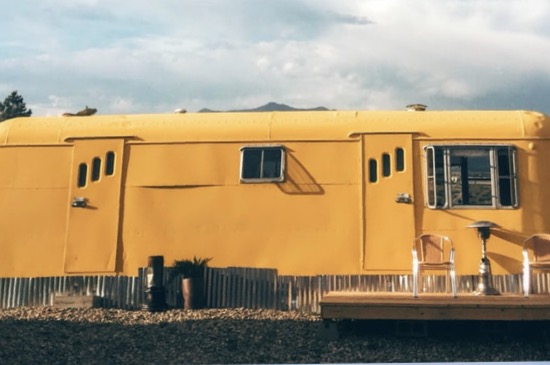
The caravan is big and old and its corners are rounded. It has very thin skin. I mean thin. The walls are not much thicker than a piece of paper. When I need to pass a rubbery gas pipe to connect a gas bottle to a cooker I use a tin opener to cut a hole in the van wall. There is no insulation from the world, the cold, the wind, the hail, the cry of the buzzard. The first winter the winds whip up the sides of the valley and smack the sides of the van liked a packed punch. In order to cure the roof leaks the previous tenants have draped blue plastic sheeting across the flat silver roof fastening it down with straps and cam buckles. The straps are so taut that the wind plays them like guitar strings. I grow accustomed to the eerie whining music and slapping sound of the straps drumming on the thin walls.
I have no electricity or running water. I collect 5 litre plastic water bottles and refill them from a copper tap that juts out from a barn wall. The tap freezes in winter. I place the book I’m reading under the bulging belly of an old dented brass oil lamp. It’s hard to read in the yellow light. I have an old formica-topped table with folding aluminium legs to write on. The ceiling blackens with burning paraffin. I find supplies of quarter inch wide wick in the local hardware store. No electricity. No TV’s, washing machines, hair dryers. The laptop stays in its zipped up padded black bag. Some of the other women who live on the land in their trucks have battery or solar operated radio’s. I hear the shipping forecast as I pass their paraffin-lit windows.
When the snow comes the field falls silent and the temperature plummets. I wear a coat and hat in bed. Someone has given me a stove an old Parkray made of cast iron. It is designed for coal. I only have wood. It reminds me of the fire box on a locomotive. The stove takes an unreasonable amount of wood to get going so I shiver through the morning, but by early afternoon, having got into its stride, the stove belts out heat at an uncontrolable rate turning the van into the tropics.
How to keep warm is always a problem, isn’t it? Mary Oliver
The subject of warmth is a central theme for others who live on the land. My friend lives in what was once a pigsty, a low, narrow structure tacked onto the wall of a bigger cattle barn. She is smart and brings her own stove. It is demonic, it catches light quickly and belts out heat. Over morning coffee and cigarettes we talk fire box size, capacity for heating up different size spaces, fuel combinations including wood, coal and multi-fuel. We become stove specialists. If the stove is too big it takes up too much space, uses too much fuel, but is easier to keep in over-night. If it is too small you have to saw wood to fit and chop logs to size and this all takes time and effort, but the small fire boxes prevent stacking so its hard to keep in overnight. When we find out how cheap the demon stove is we want to know who made it and where they live.
I take a keen interest in chimneys and stove pipes. I fit pipes to my own 'van' and then hire myself out to other van-dwellers. It’s a precise job. Working on the roof of a caravan is a delicate business. Dents in the roof caused by body weight result in water collection and water finds its way in. Once the roof of a van starts leaking it’s tricky to stop. Every breach in the paper-thin aluminium roof must be sealed. Once the stove pipe is in place I use strips of roof tar which I can heat with a blow torch and mould into any shape. The hot tar seeps in and fills fissures and cracks. Once I’ve packed the breach with tar I fit a chimney collar to seal the whole thing while making a firm and stabilising joint between roof and pipe.
The stove pipe has to clear the line of the roof to ensure sufficient draw and pull for the stove and the pipes have to be clear of wood or flammable insulation in the roof space. The pipes have to be made of hardy material so we use the cheapest, the most durable we can afford which is cast iron. The chimney pipe is heavy but bomb-proof. We are lucky, we have a blacksmith in the village - there is nothing he cannot do with metal. He makes our stove pipes and fittings precisely and cheaply. Its a lot of work but there is something fundamental, deeply empowering and necessary about making a dry, warm space to live.
I go visit the guy who makes the demon stove. He is a traveller living in a community some miles away. He has taken two twenty three foot static caravans and stuck them together. The living room and kitchen are at one end and the sleeping spaces are at the other end of this forty six foot train. There is a porch made from tarpaulin. It is littered with welllies, boots and cyles. It’s like a Walker Evans scene from the mid West. I order a wood stove big enough to heat a 22 foot space. It will have a deep fire box that will take 20 inch logs. I pick the stove up a week later. It costs £150.00 quid. The stove out lives its maker. The oblong black box is faithful to this day, it has kept me warm each winter for two decades.
My caravan is all light. When the sun rises it slowly lights the back windows filling them with pinks and gold. When it sets it turns the living room and kitchen ablaze. The cats lie full stretch on the long seat-cushions soaking up the heat. When the light fades I watch the moon rise over the soft shapes of the distant mountains that lie beyond the river. At mid winter the moon sits dead centre in the skylight and floods the small bedroom with silver light.
One evening at dusk, the form of a barn owl appears in the wall-length living room window. When I catch sight of her she is still at a distance but cruising streadily toward the van. She is flying low over a darkening field. She comes closer and closer but does not divert her course. She appears to be heading stright for the plate glass. I am paralysed by the sight of her flat white impressionless face, fixed by her gaze like a wood mouse caught out in the open. My eyes widen to take in the beauty of her form and the horror of what will happen next. She is looking straight into my eyes. At the very last possible moment she tilts her white wing tips a fraction and soars silently at speed up and over the flat roof.
….and what can my life bring me that could exceed that brief moment? Mary Oliver
Outside the van, where I have not cut back the summer growth, the oat and meadow grasses grow high. The thin golden stems follow the warm winds this way and that. The thrush sits in the undergrowth and sings. The black bodies of the bats flicker against the darkening sky. The moon rises high in the clean air. I sit on the step of the van late into the evening. The universe opens and opens and opens as the thunderous silence gathers.
Colette Power 2015