When we protect ourselves so we won't feel pain, that protection becomes like armor, like armor that imprisons the softness of the heart (Pema Chodron)
He was sitting propped up against a bin. He couldn't stop shaking, his head, hands, cheeks, legs. He was significantly underweight so that the structure of his skull was clearly visible beneath the skin. He needed to be in hospital not sitting on an icy floor in a street that provided a tunnel for the bitter winds that blow in from the Irish Sea. I walked past. I wanted to keep on walking. I stopped. I turned around and looked at him. I saw people, like me, looking, I saw the anguish in their eyes, I saw them soften and harden, I saw them turn away, I saw that single drop of suffering reflected in the faces of a hundred people, I saw the struggle and the anger and the denial.
I propped my bike up against the bin. His eyes seemed big in his sunken face like a kids' eyes. I said hello and asked what he needed. He said he needed 12 quid to get a room for the night. I gave him a tenner. I told him I'd been to sort out my vote and we talked politics. His mum had died. He said his family were expecting him to turn up to the funeral 'in the scruff'. I exhaled. No amount of fashion accessories would hide that emaciated body, the rotten teeth, the hands stained with dirt. Nothing could hide the neglect.
He said he got depressed. I said that I could understand that. He said what kept him going was the footy. Liverpool. I thought about the millions and millions the club make from the city and the footballers decadent life styles. He had resources. He said he'd tried to get a job but it was hard. I agreed.
He came from a housing estate next to where we had once lived. We talked about Kirkby and Croxteth, places we both knew, we laughed a bit and for a moment it was as if I was just talking to a friend, listening and remembering, as if all the conditions of our lives fell away and there was just the busy street and us talking about this and that. He said he was 49. I stopped talking. Something stuck in my throat. He looked 20 years older.
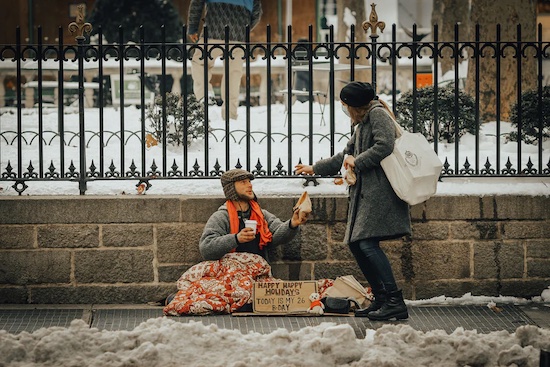
Another guy came over and asked if Stan wanted a drink and something to eat. Stan chose a hot chocolate and a pasty. The man came back with both some time later. Stan was warming his hands around the coffee cup when I looked up and saw a young boy, maybe 12 or 13 watching us from a distance. He looked a bit uneasy but looked all the same. His mum and dad stood close to him and they were watching too. They were all well dressed.
The mother came over and put some money into Stan's hand. I think it was 15 quid. She looked straight at me. It was like a transmission. When I looked into her eyes I saw sorrow, not just for Stan, but for herself, for her son growing up in this world, for all of the dreams we dream when we're young, sorrow for every single one of us, tied as we are to this wheel of suffering, and I saw defiance, I saw a woman with an iron fist kicking away the litter and the dirt and holding up kindness like a great sword, I saw someone you wouldn't mess with. In that moment as I looked into her eyes the whole street and the sleeping bags in the doorways and the filth and the blame and the sadness and regret seemed to converge into one enormous and intense moment of painless silence that seemed to contain everything and everyone.
Stan had the tenner I'd given him and the £15.00 from the family. He said, 'bleeding hell, you're gonna have to stay there all day! You're me lucky mascot. What's going on!!' We laughed and imagined what we could make by tea time, and for that moment we were happy, just for that moment.
Colette Power Liverpool, November 2019
Photo Kym McKinnon